Schools banned phones. The phone time just moved.
A study of 1,227 students in 30 UK schools found phone bans cut use in class — but total daily use and wellbeing didn't budge. The line has to travel with you.
If you want to fix a phone habit, the obvious move is to ban the phone. Governments agree: a quarter of the world’s countries now require schools to keep phones out of the school day, and the idea polls well with almost everyone who has ever watched a teenager at dinner.
So a team at the University of Birmingham did something nobody had properly done before: they checked whether it works. Their study — the first peer-reviewed evaluation of its kind, published in The Lancet Regional Health – Europe in 2025 — compared 1,227 students aged 12 to 15 across 30 English schools: twenty that banned recreational phone use during the day, ten that allowed it.
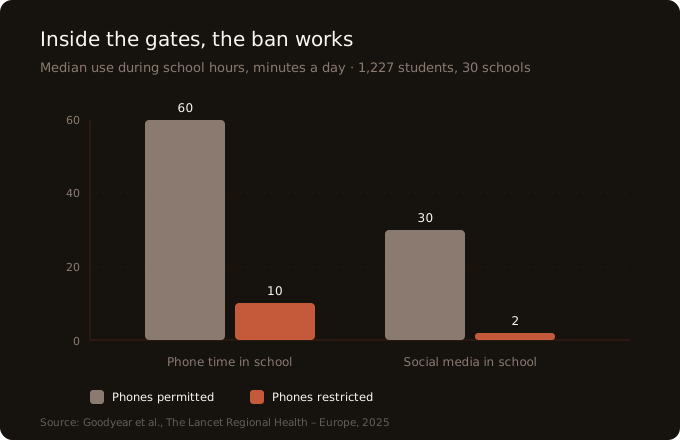
The ban did exactly what it says on the tin. During school hours, students at permissive schools spent a median of an hour on their phones. At restrictive schools: about ten minutes.
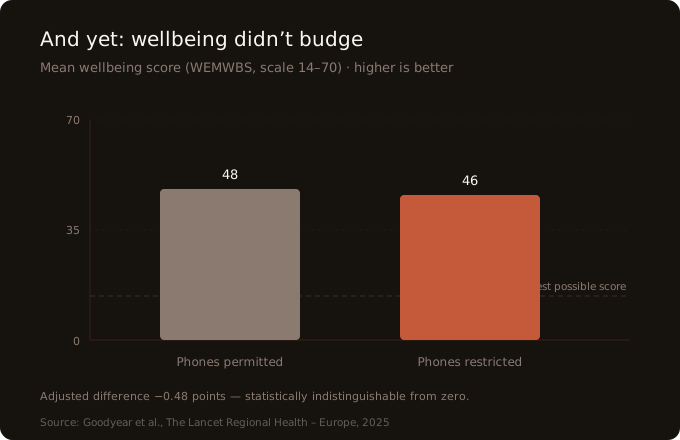
Then came the part that made headlines. The researchers measured what the bans were actually for: mental wellbeing, anxiety, sleep, exercise, grades, classroom behaviour. Across every one of those outcomes, students at ban schools and no-ban schools were statistically indistinguishable. On the standard wellbeing scale the two groups landed two points apart — a difference small enough that the analysis couldn’t tell it from zero. Even at schools where phones were physically locked away all day, nothing moved.
Where the hour went
The explanation is hiding in one number. When the researchers looked at total daily phone time — school plus evenings plus weekends — there was no difference between the two groups. Nearly everyone, banned or not, was on their phone upwards of two hours a day outside the school gates.
The ban didn’t shrink the phone time. It relocated it. The hour that used to happen at lunch now happens on the bus, at the kitchen table, in bed. The school day got quieter; the day as a whole stayed exactly the same.
And here’s the finding that keeps this from being a shrug: total time did matter. In the same study, students who spent more overall time on phones and social media had lower wellbeing, worse sleep, less exercise, and lower grades — the associations were consistent and clear. The usual caution applies: this is a snapshot, so it can’t prove which way the arrow runs. But the pattern is exactly what you’d expect if the hours themselves — wherever they happen — are what count.
So the study’s conclusion is precise, and worth stating carefully. It’s not “phones are fine.” It’s that cutting phone use in one building, for six hours, doesn’t cut phone use — and so the benefits people hoped for never had a chance to show up.
A rule that stays behind when you leave
There’s something worth sitting with here that has nothing to do with schools.
A ban is a rule that lives in a place. It works — genuinely — inside its own walls, and it expires at the door. The person walks out, the rule stays behind, and the evening is governed by nobody at all. Any adult who has ever been focused at the office and lost at 10pm knows this shape from the inside.
What the data points toward is a different kind of rule: one that’s attached to the person, not the place — covering the whole day, because the whole day is where the hours live. And rules like that only hold when the person actually chose them. Nobody can lock your evenings in a pouch for you.
That’s the quiet idea Pausa is built on. Not a wall around one room of your life, but a daily budget you set yourself — one number per app, for the whole day, everywhere you take the phone. The school study shows what happens when the line is drawn around a building. Draw it around your day instead, and there’s nowhere for the hour to move to.
You decide. Not the apps — and not the building, either.
Source: Goodyear VA, et al. “School phone policies and their association with mental wellbeing, phone use, and social media use (SMART Schools): a cross-sectional observational study.” The Lancet Regional Health – Europe, 2025. doi:10.1016/j.lanepe.2025.101211