The hour in bed that costs you 24 minutes of sleep
A study of 45,000 students found every hour on a screen after going to bed meant 24 minutes less sleep — and it didn't matter which app it was.
You know the moment. The lights are off, the day is done, and the phone comes with you under the covers — just to check one thing. Forty minutes later you’re still there, watching something you won’t remember choosing.
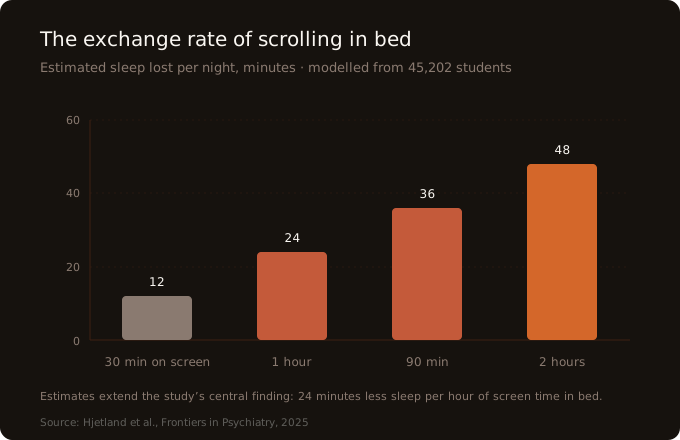
In 2025, researchers at the Norwegian Institute of Public Health put a number on that moment, and it’s a memorable one. Working with data from over 45,000 students aged 18 to 28 — one of the largest surveys of its kind — they found that every extra hour spent on a screen after going to bed came with 24 minutes less sleep, and a 59% higher chance of reporting the symptoms of insomnia: trouble falling asleep, trouble staying asleep, tired days.
Think about that exchange rate. An hour of scrolling doesn’t just cost the hour. It reaches into the night behind it and takes another chunk on the way out.
The twist: it’s not the app. It’s the clock.
Here’s the part of the study that surprised even the researchers.
Social media has a special reputation as the villain of bedtime. So the team compared people by what they actually did in bed — only social media, social media mixed with other things, or other screen activities entirely, like shows, games, or browsing. If the feeds were uniquely bad for sleep, it should have shown up here.
It didn’t. The link between screen time and worse sleep was the same regardless of activity. Hour for hour, a feed cost you no more sleep than a series. And in a finding nobody would have predicted, the group that used only social media in bed actually reported the least insomnia and the most sleep — nearly half an hour more per night than the group that skipped social media for other screen activities.
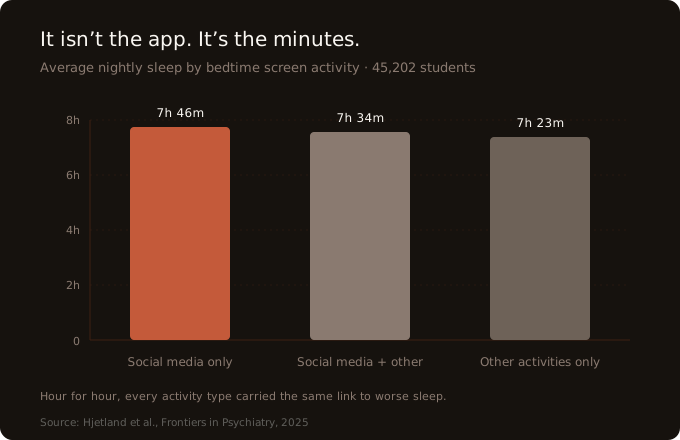
The researchers’ explanation is disarmingly simple: screens mostly hurt sleep by taking up time you would otherwise be sleeping. Not primarily the blue light. Not some special property of the feed. Displacement. The minutes go somewhere, and they come out of the night.
The honest caveats, because they matter: this is a snapshot study, so it shows a strong link, not proof of cause — it’s possible that people who sleep badly reach for their phones more, not just the reverse. The numbers are self-reported. And students aren’t everyone. The researchers say all of this plainly, which is part of why the study is worth your attention.
Why this is quietly good news
If the cost came from the apps themselves — some spell the feed casts on your brain — you’d have to quit them to sleep well. But if the cost is mostly minutes, then the fix is mostly minutes too. You don’t need a different phone or a moral victory. You need the hour back.
That reframe matters, because “I should stop scrolling at night” is a rule that has to be re-won every single evening, in the dark, tired, against apps built to make the next minute feel effortless. That’s the worst possible moment to be negotiating with yourself. The students in this study weren’t weak-willed; they were just the only party at the table who ever gets tired.
This is where a decision made in daylight beats a decision made at midnight. Decide once how much of your day each app gets. Let something else hold that line at 11pm, when you’re least equipped to hold it yourself. Pausa was built for exactly that handoff — a daily budget you set while you’re clear, kept for you when you’re not, with an evening wind-down if you want your nights fenced off entirely.
The study’s arithmetic is blunt: the hour in bed isn’t free. But whose hour it is — that part is still yours to decide.
Source: Hjetland GJ, Skogen JC, Hysing M, Gradisar M, Sivertsen B. “How and when screens are used: comparing different screen activities and sleep in Norwegian university students.” Frontiers in Psychiatry, 2025. doi:10.3389/fpsyt.2025.1548273