What two weeks without mobile internet does to your attention
Scientists paid 467 people to switch off the internet on their phones for two weeks. What happened next is worth two minutes of your time.
Imagine someone offered to turn off the internet on your phone for two weeks. Texts still work. Calls still work. Your laptop’s fine. But the thing in your pocket goes quiet — no feed, no scroll, no quick check.
Could you do it? And if you did — would anything actually change?
In 2025, researchers at five universities ran exactly that experiment with 467 adults. They had people install an app that blocked mobile internet, and they watched what happened. This wasn’t a survey asking people how they felt. It was a real trial — half the group switched off first, then they swapped, so any effect had to show up twice to count. That’s the kind of study that’s hard to argue with.
Here’s what they found.
People got their time back — about two and a half hours of it
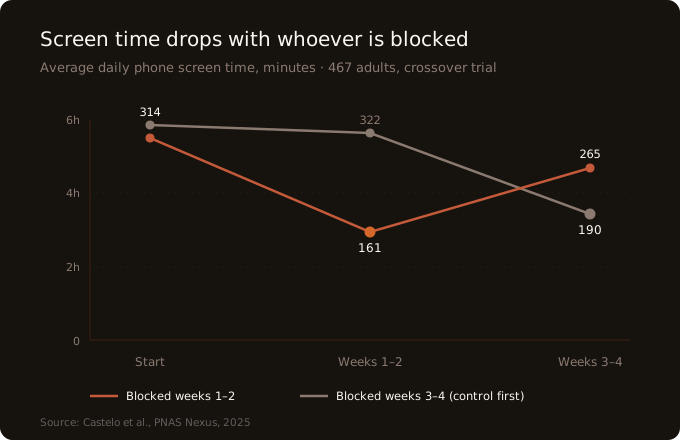
Before the experiment, the average person was on their phone roughly five hours a day. With mobile internet switched off, that dropped by about half. Two and a half hours, handed back, every single day.
That alone isn’t surprising — take away the internet, people use their phones less. Of course. The interesting part is what that freed-up time did to them.
Almost everyone felt better in some way
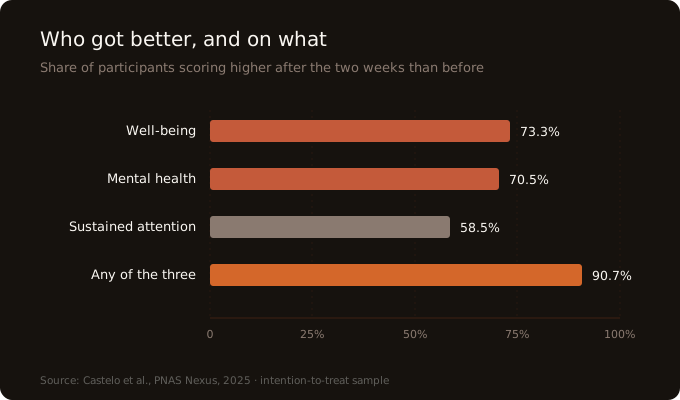
Three things got measured: their mood, their mental health, and their ability to focus. By the end of the two weeks, nine out of ten people had improved on at least one of them.
Focus was the hardest to shift — a bit more than half got sharper there. But mood and mental health moved for most people. And the size of the mental-health bump was genuinely surprising: the researchers found it was bigger than what you’d typically get from antidepressants, and the attention boost was, in their words, like erasing ten years of age-related decline. (Their comparison, not ours — and they’re careful to say two weeks isn’t the same as a clinical trial.)
So why isn’t everyone doing this?
Because almost nobody can actually keep it up.
Out of 467 people who signed up for this, only about a quarter managed to keep the internet off for the full two weeks. The rest drifted back. And the moment the experiment ended, screen time started creeping toward where it began.
That’s not people being weak. It’s what happens when a rule depends on you winning a small argument with yourself every single time you’re bored. Standing in a queue. Waiting for the kettle. Lying awake. The phone is right there, the internet is one tap away, and you have to say no again, and again, and again. Nobody wins that fight forever.
The part that actually matters
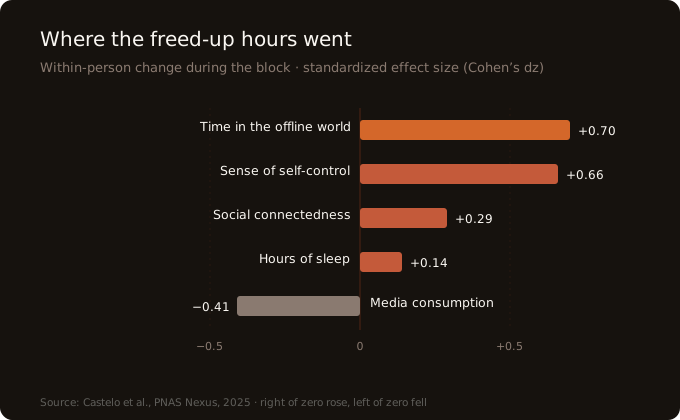
The researchers dug into where the reclaimed time went — and that turned out to be the real story.
People didn’t just sit there. They spent more time with other people, face to face. They went outside. They exercised. They slept a little more. And those things — not the absence of the phone, but the presence of everything the phone had been quietly crowding out — were what made them feel better.
So the lesson isn’t “throw your phone in a drawer.” It’s quieter than that. The good stuff wasn’t hiding inside the phone. It was waiting on the other side of it.
You don’t have to go cold turkey
Here’s the bind the study leaves you in. The thing that worked — switching the internet off completely — is the thing hardly anyone could stick to. So what do you do with that?
You find the middle. You don’t need to make your phone dumb to get the hours back. You just need to decide, while you’re calm and clear, how much of your day each app gets — and then not have to decide it again every tired evening.
That’s the whole idea behind a daily budget. You set the number once. Your phone keeps the count. What’s left over isn’t taken from you — it’s just yours again, to spend on the kind of things those 467 people did, and felt better for.
The study proved the upside of a quieter phone. The hard part was never willpower. It’s just deciding who’s in charge — you, or the apps — and deciding it once.
Source: Castelo N, Kushlev K, Ward AF, Esterman M, Reiner PB. “Blocking mobile internet on smartphones improves sustained attention, mental health, and subjective well-being.” PNAS Nexus, 2025. doi:10.1093/pnasnexus/pgaf017